
Canonical is sharpening Ubuntu into an AI-native platform that removes years of friction from model development, deployment, and hardware enablement — so engineers can focus on models, not drivers.
AI development historically requires wrestling with kernel modules, vendor-specific repositories, and delicate driver versions. The next wave of Ubuntu releases changes that by baking hardware support and AI tooling directly into the base OS. This article distills the key announcements and practical implications from Jon Seager's talk on Ubuntu's AI strategy, with a focus on the upcoming 26.04 LTS release, silicon partnerships, Inference Snaps, and long-term maintenance guarantees.
The 26.04 LTS breakthrough: apt install CUDA/ROCm
Ubuntu 26.04 LTS introduces a paradigm shift for AI developers: the ability to install GPU and accelerator drivers and toolkits directly from the base distribution with commands like apt install cuda or apt install rocm. That simple UX removes a long-standing pain point — the need to add and maintain vendor-specific repositories and to manually reconcile kernel and driver mismatch issues.
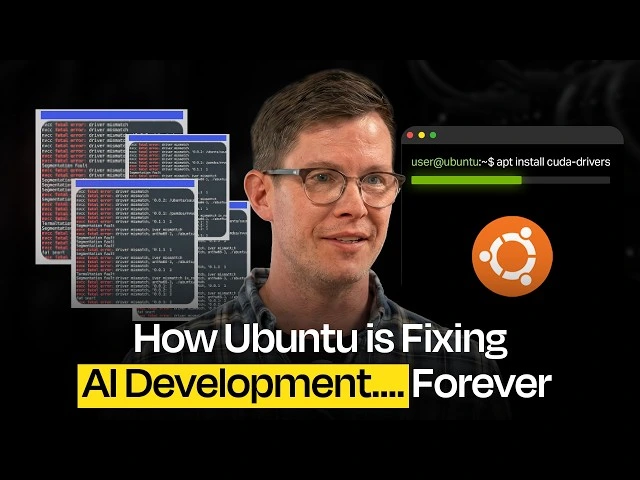
For developers and ops teams this means faster onboarding, fewer environment-specific bugs, and a reproducible baseline across workstations, laptops, and cluster nodes. Instead of spending days debugging driver permutations, teams can provision identical stacks and get to model iteration and benchmarking quickly.
Why this matters
- Reduced setup time — developers can get a working CUDA/ROCm stack in minutes instead of hours or days.
- Fewer environment regressions — apt-managed drivers align with Ubuntu kernel updates and security policies.
- Better reproducibility — consistent base images for CI, local development, and production clusters.
"No more manual repository wrangling or driver nightmares — Ubuntu 26.04 brings drivers to the base system."
Silicon partnerships and day-one kernel support
Canonical's close collaboration with silicon vendors — NVIDIA, AMD, Intel, Qualcomm and others — is central to Ubuntu's strategy. By coordinating kernel and platform integrations upstream, Canonical ensures day-one kernel support for NPUs, TPUs, and other accelerators, so newly announced hardware works out of the box with Ubuntu systems.
This is more than marketing: it means the distribution maintains a tight testing and validation loop that covers the kernel, driver stacks, and platform firmware. Enterprises and researchers benefit from lower integration cost and faster access to the newest acceleration technologies.
NVIDIA and the DGX Spark AI workstation
A compelling signal of confidence is NVIDIA's decision to ship the ARM64-only DGX Spark AI workstation with Ubuntu as the native, branded OS. Rather than a custom DGX-branded Linux, the workstation calls out Ubuntu directly — a strong endorsement of Ubuntu's reliability for AI-ready hardware.
"Ubuntu has been here all along, powering the vast majority of today’s AI workloads across every major cloud provider."
Inference Snaps: open-source, silicon-optimized model packaging
Canonical introduced Inference Snaps — a new open-source mechanism for packaging optimized models and inference runtimes into confined, secure snaps. Each Inference Snap bundles the model, a tuned inference engine, and the required runtime in a single, discoverable package that can be installed with snap install.
For hobbyists and developers, Inference Snaps provide an easy path to experiment with production-grade models (examples include DeepSeek, Gemma, Neotron, Quen) without wrestling with dependency hell. For teams, snaps simplify deployment by providing a consistent, sandboxed runtime across desktops, edge devices, and servers.
Agent sandboxing and disposable instances
Developers building AI agents or integrating experimental code will appreciate Ubuntu's tooling for safe sandboxing. LXD enables persistent system containers and lightweight VMs for isolating agents, while Multipass provides disposable Ubuntu instances across macOS, Windows, and Linux for quick cloud-like sandboxes. Combined, these tools let teams test agents and models without risking host stability.
- LXD: system containers for isolated, reproducible environments
- Multipass: fast, disposable Ubuntu instances for experimentation
A 15-year promise: long-term security maintenance for the AI stack
Canonical's commitment to long-term security maintenance for the AI stack — including drivers, runtimes, and even containerized applications — is a differentiator for enterprises. With up to 15 years of maintenance, organizations can confidently deploy models and infrastructure knowing critical CVEs and regressions will be managed upstream.
This promise reduces operational risk and lets teams prioritize model development, experiment cadence, and product features over chasing patches and retrofitting security fixes in production AI environments.
Practical takeaways for engineers and teams
- Start with a reproducible Ubuntu 26.04 LTS base image for development and CI.
- Use apt-managed CUDA/ROCm packages to align driver lifecycles with kernel updates.
- Adopt Inference Snaps for prototype-to-edge model parity and safer local experimentation.
- Leverage LXD and Multipass to sandbox agents and avoid host contamination during testing.
In short, Ubuntu's suite of improvements—from apt-installable driver stacks and Inference Snaps to deep silicon partnerships and extended maintenance—represents a strategic effort to make AI development less about infrastructure plumbing and more about creative model building. Whether you manage a research cluster, an edge fleet, or a developer workstation, there are immediate benefits to adopting Ubuntu's AI-native toolchain.
If the goal of modern AI infrastructure is to remove repetitive, error-prone tasks so teams can iterate faster, Ubuntu 26.04 LTS and Canonical's platform investments make that goal practical. The result is a smoother developer experience, faster time-to-insight, and infrastructure you can trust for the long haul.
Video URL